
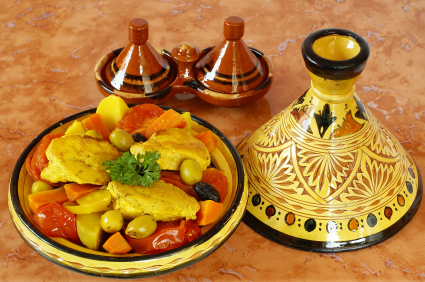
Originating in Northern Africa—specifically Morocco—tagine (sometimes mispronounced tangine) is a stew made of meats and vegetables and traditionally cooked in a conical clay pot for which the cuisine is named after. The tagine pot's shape is meant to allow steam to rise, condense and drip back down into the stew. Tagines are traditionally prepared on top of a portable clay majmar under which people put hot coals. Practically anything can be turned into a tagine: meat, chicken, fish, vegetables and some even make it with meat and fruits. Every part of the country has its regional tagine dish and different ways of preparing it. Because this meal takes a long time to prepare, the woman of the house starts preparing the lunch tagine as soon as breakfast is over.
Moroccan cuisine is filled with intense flavors and unique combinations. While other African food is defined by its spiciness, Moroccan food is characterized by its fusion of sweet and savory tastes. Specialties vary regionally, but certain foods are widespread such as khoobz (pita bread), kefta (minced lamb or beef with spices) and mechoui (roasted stuffed lamb). Generally, Moroccan dinners usually include mezze (different small salads), couscous, a variety of tajine and bastilla (similar to a meat pie). Popular desserts include sfaa (couscous with cinnamon, dried fruit, nuts and cream) and various almond-based indulgences. Mint tea is one of the most common beverages, as is coffee and fresh-squeezed orange juice.
You can buy simple tagine pots from World Market, or more elaborate tagine pots from Williams-Sonoma.
Ingredients:
- ½ Chicken, in pieces
- 3 medium carrots, peeled and cored (if core is bitter) and sliced in half lengthwise
- 1 large peeled potato, cut in 1/2 inch thick rounds
- 1 large green bell pepper, cut in chunks
- 1 medium red onion, cut in 1/2 inch thick rounds
- 2 medium tomatoes, cut in 1/2 inch thick rounds
- Handful of pitted green olives
- 2 cloves garlic, sliced
- 2 teaspoons ground ginger
- ½ teaspoon ground pepper
- 2 teaspoons paprika
- ½ cube or 1 teaspoon chicken bouillon powder
- Dash of yellow food colorant powder, or a few strands crushed saffron
- 1-2 teaspoons salt (to taste)
- 6-8 tablespoons of olive oil
- 1/4 cup of water
Preparation:
- Splash 4 tbsp of oil on the bottom of the tagine
- Layer your ingredients evenly in the tagine in this order: carrots, chicken, potatoes, bell pepper, red onion, tomatoes, garlic, ginger*
- When you get to the spices and salt, sprinkle them evenly over the vegetables
- Spread your olives on top
- Drizzle the olive oil all over everything
- If water is needed, add it now
- Close your tagine and cook until your vegetables are tender, on a very low heat, this may take up to one hour**
- Once it's cooked, turn off the heat and you can drizzle olive oil on top if preferred
- Let the tagine rest for about 10 minutes to cool off, and enjoy!
* The carrots must be on the bottom, and the chicken pieces should be on top of the carrots, not touching the bottom of the tagine. When the carrots start to burn they add delicious flavor and protect the rest of the ingredients, but if anything else burns that's not going to taste very good.
** Make sure you have liquid in the tagine or it will burn. Watch out for too much liquid, or it will bubble over.
Recipe by Ian Williams

- Details
- Hits: 6369
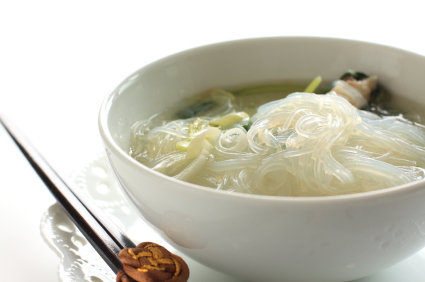
Chicken Long Rice is a dish that is popular at Hawaiian luaus but its origins are from Chinese cuisine that was brought over with Chinese immigrants working on sugar plantations in the mid 1800s. Chinese men who worked on the sugar plantations intermarried with Hawaiian women and the Chinese dish evolved into the uniquely Hawaiian Chicken long rice enjoyed today. Chicken long rice consists of a soupy mixture of chicken, a noodle-like ingredient made from mung beans called long rice (although it goes by many different names including bean noodles, glass noodles, or cellophane noodles), ginger and onions, all in a flavorful chicken stock. It is a simple dish that is very popular at Hawaiian luaus.
The luau is a tradition that started around 1819 with King Kamehameha II when he abolished the practice of separation of genders and classes during celebrational feasts. Before the tradition of luaus, Hawaiian people were separated by class and gender when having feasts known as 'aha'aina to celebrate life milestones. Because of Kamehameha II, the luau replaced the 'aha'aina tradition. The word luau is the Hawaiian name for the taro leaf which is eaten at such feasts. Taro was highly regarded by Hawaiians because it was one of their main staple foods and essential to their survival. So important was taro that it was considered in their religious mythology as the elder sibling to the Hawaiian people. Traditional luaus were a major event and usually included hundreds, and sometimes possibly even thousands, of people. Today people still practice luaus but on much smaller scales; usually friends and family come together to celebrate special events.
Ingredients:
- 2 1/2 pounds of chicken thighs
- 3 quarts of water
- 1 tablespoon of salt
- 1 1/2 tablespoons minced ginger root
- 1 large onion, finely chopped
- 5 chicken bouillon cubes
- 8 ounces of long rice
- 3 green onions, chopped
Preparation:
- Put the chicken into a 5 quart saucepan
- Add 2 quarts of the water, the salt and ginger
- Bring to a boil, skim, lower heat, and simmer for forty minutes
- Remove from heat and drain, while saving the broth
- Remove meat from chicken, while discarding the bones
- Shred the meat and set aside
- Put broth, onion, bouillon cubes and the remaining 1 quart of water into saucepan
- Bring the broth to a boil
- Add the long rice, then lower the heat and cook, covered for 5 minutes
- Turn off heat and let stand about 30 minutes
- With kitchen shears, cut the long rice into approximately 3 or 4 inch lengths
- Stir in the chicken and heat briefly before serving
- Sprinkle with green onions
- Add soy sauce to taste if desired
* This recipe uses traditional ingredients. Many people now add additional vegetables such as what one might add to a stir fry.
Recipe submitted by Ian Williams
- Details
- Hits: 6601
In many cultures, the first day of Spring (aka the vernal equinox) is celebrated as the first day of the New Year. In Iran and some neighboring cultures, these observances are known as Nowruz (Romanized spellings differ) which means "New Day" or "New Light." The precise origins of Nowruz—believed to be a Zoroastrian observance—are shrouded in the mists of history, but it is certainly ancient.
In Iran the present day celebrations last 13 days. It is a time to quite literally "clean house" (something nearly all Iranians partake in), buy new clothes for the new year, exchange gifts (on the exact moment of the start of spring) and visit friends, family, and neighbors. There are, in fact, a delightfully extravagant number of rituals and customs observed for Nowruz. Enjoying the great outdoors, picnicking, and visiting parks and the countryside are highly favored Nowruz activities.
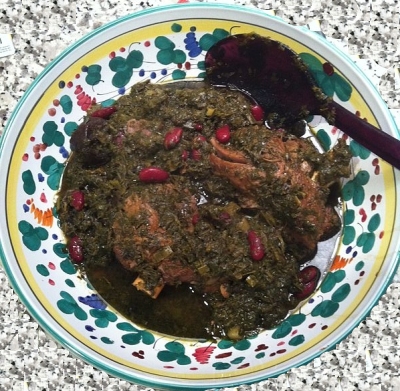
The word "Sabzi" in the recipe below means "green herbs." On the night before the first day of Nowruz, many if not most Iranians will enjoy Sabzi Polo Mahi, a dish consisting of rice cooked with green herbs served alongside smoked and fried fish. Unsure of the local availability of the right kind of smoked fish (although people do improvise with other sorts of fish when the need arises) the recipe of the month describes a different way of cooking with Sabzi.
Although not a dish specific to Nowruz, Ghormeh Sabzi is an exceedingly popular dish in Iran. Iranian food often employs a great deal of herbs such as mint, dill, parsley, basil, fenugreek leaves, chives, etc. Persian cuisine goes back a long way.
The oldest surviving cookbook is the Kar-nameh dar bab-e tabbakhi va sanat-e an ("Manual on cooking and its craft") written in 927 A.D. As Iran is a vast country with many different regions, there is a great deal of variation in the cooking found there.
Rice is a staple of Iranian cooking and over the centuries Persian cooks have devised many ingenious (and somewhat complicated) methods of cooking and preparing it. Celo rice is rice that is browned and made crispy (the crust is known as Tah Dig employing clarified butter and/or yogurt). Iranian and Afghani rice cookers differ from East Asian ones in that the former can create the desired tah dig crust.
Another popular method of cooking rice in Iran is called polo (variously spelled, similar to rice pilaf which is a derivative) which is rice either mixed or cooked with herbs and other ingredients. And there is keteh rice which is plain white rice cooked by the absorption method. There are also regional varieties of rice in Iran, most resembling Indian or Pakistani basmati rice.
Many Iranian cooked dishes contain fruits (or fruit juice) such as apricots, cherries, plums, pomegranates, prunes, and raisins. Dried limes (limoo amani) are often used in stews to add a bit of piquant bite.
Ingredients:
- 1 - 1 1/2 pounds of stew beef or lamb diced into 1 inch cubes
- 1 can of kidney beans, drained and rinsed¹
- 4-5 dried limes (limoo amani) perforated (depending on size)
- Juice from 1 lemon
- 1 large onion chopped fine
- 4 garlic cloves chopped fine
- 1 1/2 cups of chopped Spinach
- 1/2 cup of finely chopped flat leaf Italian parsley
- 1/2 cup finely chopped cilantro
- 1/4 cup finely chopped chives or scallion (green onion)
- 1/4 cup finely chopped fenugreek leaves (shanbalileh)
- 1 teaspoon turmeric powder
- Salt and pepper to taste
- 2 cups of water
- Hi-temp cooking oil (Ghee, Grape seed, Safflower, Peanut, Light (not virgin!) Olive Oil)
- Optional ingredients for this recipe are potatoes and leeks.
¹ Note regarding beans. You may prefer to use dry beans for this recipe. If so, use the equivalent of half as much as canned beans. Soak the beans for 5 hours or more (overnight is best). Drain the soaking water and then vigorously boil the beans for 10 minutes. Add the beans at the beginning of the simmering process (at step 11 below), not the middle.
Preparation:
- Sauté the onions in a tablespoon or two of oil on medium heat, in large flat-bottomed pot or iron casserole.
- About 2 minutes later, add the garlic.
- Stir unions and garlic frequently until the onions are fully translucent.
- Add turmeric powder and continue heating for an additional 2 minutes.
- Fully dry the beef or lamb with paper towels or a clean cloth (this helps browning significantly).
- Turn the heat up to medium high and add meat to the casserole and brown on all sides.
- Remove casserole from burner.
- Add 2 tablespoons of oil to a new deep frying pan and heat to medium high.
- Sauté the spinach, parsley, cilantro, chives (or scallion tops) and fenugreek leaves in the oil until they darken and just start to brown. Don't burn them or they will turn very bitter!
- Add the sautéed greens and water to the casserole, turn on the heat and bring to a simmer.
- Cover the casserole and simmer for 45 minutes.
- Poke a couple of holes in each of the dried limes, being careful not to poke any holes in your hands. I use the point of a knife sharpening steel. It works like a charm.
- Add the perforated dried limes, lemon juice and beans to the casserole and stir.
- Add pepper and salt to taste.
- Cook for an additional 45 minutes or longer testing the tenderness of the meat (which should be quite tender).
- Add more water if necessary; this dish should be the consistency of stew, not soup.
- Optionally remove the dried limes before serving. They are very sour and quite an adventure to bite into.
- Serve over the Kateh rice. A side dish of plain Greek style yogurt or tzaziki is a nice complement.
Kateh Rice Preparation:
Kateh is the easiest Iranian rice to cook, but it is nevertheless greatly savored. Ghormeh Sabzi is commonly served over Kateh rice. Basmati rice, now commonly available in the United States, is similar to Iranian forms of rice and in fact is widely available in Iran. Many cooks and recipes call for rinsing basmati rice until the water is clear. As we have discussed about Japanese rice, this step is optional. In our experience, rice sold in the U.S. is very clean and basmati rice is not overly starchy. Rinsing the starch that is present is not too good for the environment. However, Basmati rice does improve in taste and texture if it is pre-soaked. Pre-soaked rice also cooks faster. Older aged rice needs more water to cook than recently harvested rice. But I had good success with the following method. Measure out the amount of rice you desire (cooked rice is about 3 times the volume as uncooked) into a medium sized saucepan. For this recipe 2 - 3 cups would work out fine. Add water in proportion to 1 1/2 cup to each cup of rice. Let the rice soak for 20 minutes or more. Salt the water (to your taste, you can also add some ghee or butter at this point) and then put the rice on the stove and bring to a boil on high heat. As soon as the water begins to boil, cover the pot and reduce the heat to low. Some Iranian cooks wrap the pot lid with a clean cloth (like a dish towel) before covering the pot to get a good seal. My mother actually employed this method (and she was not Persian) and it works fine. The rice should take about 20 minutes to fully cook. After serving rice, the best thing to do is to store the excess in your freezer.
Recipe by T. Johnston-O'Neill
Photo by Shari K. Johnston-O'Neill
- Details
- Hits: 6201
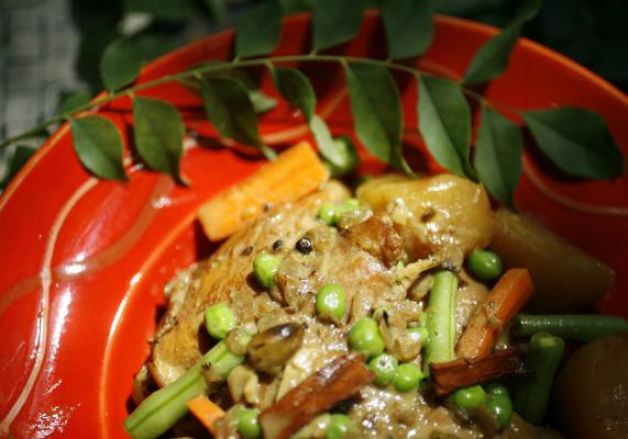
Photo from the Complete Book of Indian Cooking
Kerala is on the Southwest coast of India. It is a hot and wet land of tremendous ethnic and religious diversity, forged out of its long and varied history. Earliest habitation dates back to at least the peoples responsible for the Edakkal Cave pictorial writings that may be more than 7,000 years old. For several millennia, Kerala has been one of the most important trading centers in the world. Before European contact, Kerala was ruled by a plethora of Indic empires including the Chera, Ays, Pandyan, Chola, and Rashkatraka. In a bid to take over the spice trade largely controlled by the Arabs, the Portuguese under Vasco de Gama established a fort at Cochin. Today the area is still known as Fort Kochin. The Portuguese were eventually expelled by the Dutch but in the late 1700s they were ousted by local Nayar (Nair) troops under Marthanda Varma. A short few years later, a series of wars between the English and the rulers of Mysore eventually resulted in treaties establishing the area as "Princely State" in British India. Subsequent uprisings against British rule were not uncommon. But western influence in Kerala was not limited to military, political, and economic engagements. Kerala is a land of great religious diversity. While Hindus and Muslims make up a majority of the area's residents, they are not and were not alone.
From perhaps as far back as 3 millennia ago, Jews were trading with India. The first wave of large scale immigration of Jews appears to have happened after the siege of Jerusalem in 70 A.D. A second large scale migration, this time Sephardic (aka Paradesi) Jews escaping the Inquisition, occurred in the 16th century. Both sets of migrants enjoy a great deal of freedom, power, and influence, although tensions did exist between the two groups themselves. The oldest Jewish grave stone in Kerala dates from 1269 C.E. Upon the establishment of the modern state of Israel, most Keralan Jewish families emigrated away from Kerala and now very few remain.
Kerala presently has a very large and active Christian community. Churches large and small are found far and wide and are variously known as Nasarani, Syrian, or St. Thomas Christians, as it is thought that St. Thomas himself evangelized Kerala in the first century. Up until the 14th century, the "Church of the East" was centered in Persia and its influence stretched all the way to China. Today, the last vestiges of this once great tradition are to be found primarily in Kerala.
These many historical, religious, and cultural traditions have left their distinctive marks on local existence. Other than the obvious differences in religious observations and traditions, and some differences in ritual and everyday dress, one of the most recognized differences are in food. With the exception of Jewish cuisine (although one can eat in the Menorah Cafe in the Koder House Hotel, the fare is not particularly Jewish), Hindu vegetarian food, and halal Muslim eats and foods that are associated with Christian Keralites can be found throughout the Fort Cochin area. The following recipe, which uses ingredients found in other Indian cuisines, is considered to be a Syrian Christian dish.
Ingredients:
- 2 pounds skinless boneless whole chicken thighs
- 2 tablespoons oil (coconut is best)
- seeds from 6 green cardamom pods (crack open, use seeds only)
- 6 whole cloves
- 1 stick cinnamon
- 1/4 teaspoon black peppercorns
- 2 bay leaves
- 2 1/2 cups finely chopped onions
- 2 Thai chilies, sliced lengthwise and seeds removed
- 1 tablespoon minced peeled ginger root
- 1 teaspoon powdered fennel seeds
- 1/4 teaspoon turmeric
- 1 1/2 teaspoon salt
- 6 small potatoes, quartered (about 3/4 pound)
- 1 cup chopped green beans (2-inch)
- 1 cup sliced carrots
- 20 fresh curry leaves
- 2 tablespoons peeled and julienned fresh ginger
- 2 tablespoons minced garlic
- 1 can of coconut milk or fresh coconut milk (14 oz)
- 1/2 cup frozen peas, thawed
Preparation:
- Rinse chicken and thoroughly pat dry with paper towels. Set chicken aside.
- In a deep saucepan, heat oil over medium heat.
- Add cardamom, cloves, cinnamon, peppercorns, and bay leaves to pan and sauté until fragrant (about 40 seconds).
- Add chopped onions and sauté until golden, 10 to 12 minutes (if onion edges start to burn, lower heat).
- Add chilies, minced ginger, fennel, and turmeric and sauté for an additional 2 minutes.
- Push fried masala mixture to side of pan. Add chicken, folding each piece to double the thickness. Spoon masala over top and brown for 5 minutes.
- Flip chicken to brown other side for an additional 3 minutes.
- Stir chicken in the pan to mix well with masala.
- Add 1 cup water and salt. Bring to a simmer.
- Reduce heat to medium-low, cover and simmer until chicken is partially cooked (about 15 minutes).
- Add potatoes, green beans, carrot, curry leaves, julienned ginger, and garlic to pan with chicken.
- Increase heat to medium and return to a simmer, then reduce heat to medium-low.
- Cover and simmer for another 10 minutes.
- Add coconut milk and peas. Continue to simmer until vegetables are tender, 6 to 8 minutes.
Serve hot over rice.
Recipe adapted from the "Complete Book of Indian Cooking," by Suneeta Vaswani
- Details
- Hits: 6044
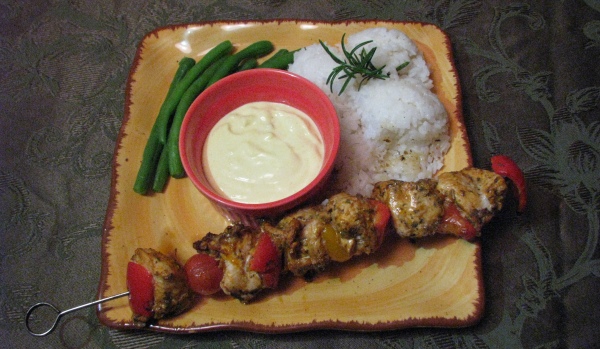
Pinchos Marunos or "Moorish Kababs" are Spanish tapas enjoyed in tabernas (taverns) throughout much of Spain. Tapas (from the Spanish verb tapar meaning "to cover") are snacks eaten between meals, usually along with generous amounts of wine. The origin of their name may have come from the custom of covering a glass of wine with a piece of bread or meat to keep insects at bay. There are innumerable types of tapas but they are not so much a kind of food as a style of eating. Often tapas are eaten whilst standing at a tapas bar conversing with one's friends and acquaintances. As free-flowing sociality is key to their enjoyment, tapas are not generally served in restaurants or at home per se, although some of the exact same dishes can be served as appetizers. The dish goes well with wine or port.
Although found throughout Spain, tapas are most popular in Andalusia, sometimes referred to as "Moorish Spain," as the area was for more than 700 years governed by Muslims. Despite this history, Pinchos Marunos might have been brought to Spain by more recent immigrants from Northern Africa. Ironically, present day Pinchos Marunos are usually made with pork, which is haram (forbidden) to Muslims. Chicken or beef can also be used with delicious results. While "all meat" kabobs are typical, cherry tomatoes, red bell peppers, and even fruits such as honeydew melons or grapes can be added for a taste twist.
Allioli, or garlic and lemon mayonnaise, is a very popular ingredient or accompaniment in Spanish cooking. While allioli is a bit labor-intensive to make in the traditional way (lots of whisking required), a reasonable approximation can be achieved using regular mayonnaise flavored with garlic and lemon juice. Pinchos Marunos can be eaten with or without a sauce like the saffron-infused allioli presented here.
Ingredients:
- 2 tablespoons chopped yellow onions
- 4 large garlic cloves, chopped fine
- 1 tablespoon sweet (preferably smoked) paprika
- 1/4 teaspoon cayenne pepper (or twice that if you have hot paprika)
- 1 teaspoon dried oregano
- 2 teaspoons drived thyme
- 1 teaspoon ground cumin
- 1/8 teaspoon ground cinnamon
- 1 bay leaf, crumbled
- 2 tablespoons white wine vinegar
- 2 tablespoons dry white wine (optional)
- 3 tablespoons olive oil
- 1 1/2 pounds of chicken breasts cut into 3/4" cubes (pork or beef may be substituted)
- Salt and pepper to taste
Preparation:
- Combine all of the ingredients except the meat in a food processor and grind into a paste.
- In a large bowl, thoroughly mix the spice paste and the meat cubes.
- For best taste, refrigerate the marinaded meat for 4 to 6 hours.
- If using bamboo skewers, soak them in water for a half hour prior to using them.
- Skewer the meat. If you are adding other ingredients such as tomatoes or sweet peppers, alternate with the meat.
- Grill over a medium heat on your BBQ until the desired doneness is achieved.
- Serve as a tapas allowing guests to drizzle (or spoon, the stuff should be thick) the saffron allioli on top of the meat.
Saffron Allioli
Allioli, or garlic and lemon mayonnaise, is a very popular ingredient or accompaniment in Spanish cooking. While allioli is a bit labor-intensive to make in the traditional way (lots of whisking required), a reasonable approximation can be achieved using regular mayonnaise flavored with saffron, garlic and lemon juice.
Ingredients:
- 2/3 cup extra-virgin olive oil
- 1/3 cup canola oil
- 4 large garlic cloves, minced finely or crushed in a garlic press
- 2 large egg yokes
- 4 teaspoons of fresh lemon juice
- salt
- several strands of saffron
Preparation:
- Pulverize the saffron strands in a mortar and then add two tablespoons of boiling water. Let cool.
- Mix oils in a measuring cup that has a spout or pouring lip.
- In a mixing bowl, mix the minced garlic cloves, egg yokes and lemon juice until they form into a consistent a paste.
- Very very slowly (in a very small stream) add the oil to the mixture. It should emulsify while blending.
- When thickened, whisk in the saffron and water.
- Whisk in salt a little at a time, until the level of saltiness you enjoy is achieved.
Quick Way:
Crush the garlic in a garlic press and then combine all the ingredients above (except the eggs and oil) with one cup of your favorite mayonnaise.
Recipes adapted from Anya von Bremzen's The New Spanish Table.
- Details
- Hits: 5996
Joomla!
Extensions
The Joomla! content management system lets you create webpages of various types using extensions. There are 5 basic types of extensions: components, modules, templates, languages, and plugins. Your website includes the extensions you need to create a basic website in English, but thousands of additional extensions of all types are available. The Joomla! Extensions Directory is the largest directory of Joomla extensions.
Components
Components are larger extensions that produce the major content for your site. Each component has one or more "views" that control how content is displayed. In the Joomla administrator there are additional extensions such as Menus, Redirection, and the extension managers.
Modules
Modules are small blocks of content that can be displayed in positions on a web page. The menus on this site are displayed in modules. The core of Joomla! includes 24 separate modules ranging from login to search to random images. Each module has a name that starts mod_ but when it displays it has a title. In the descriptions in this section, the titles are the same as the names.
Content Modules
Content modules display article and other information from the content component.
User Modules
User modules interact with the user system, allowing users to login, show who is logged-in, and showing the most recently registered users.
Display Modules
These modules display information from components other than content and user. These include weblinks, news feeds and the media manager.
Utility Modules
Utility modules provide useful functionality such as search, syndication and statistics.
Navigation Modules
Navigation modules help your visitors move through your site and find what they need.
Menus provide your site with structure and help your visitors navigate your site. Although they are all based on the same menu module, the variety of ways menus are used in the sample data show how flexible this module is.
A menu can range from extremely simple (for example the top menu or the menu for the Australian Parks sample site) to extremely complex (for example the About Joomla! menu with its many levels). They can also be used for other types of presentation such as the site map linked from the "This Site" menu.
Breadcrumbs provide users with information about where they are in a site.
Page 25 of 33