
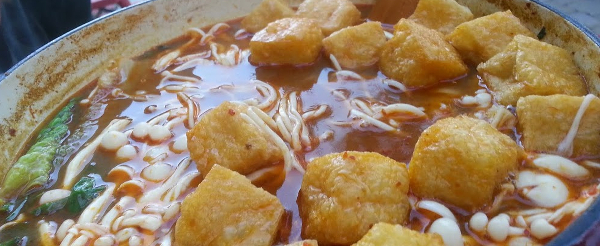
Chongqing Hot Pot is a great party dish to share with friends. We give you the low down on all the variations and styles. It looks like a soup, but it is not eaten like one. Everything is dipped in a sour and savory sauce before consuming.
Chongqing is a major city in southwest China. Administratively, it is one of China's four direct-controlled municipalities (the other three are Beijing, Shanghai and Tianjin), and is the only such municipality in inland China. The Yangtze and Jialing rivers flow through the city making it a busy trade entrepot. In days gone by, the city had many many ports and docks.
Chaotian Men (meaning "a door at the top of the sky") port was and is the busiest port in Chongqing. It is located where the Yangtze and Jialing rivers meet. Historically, there were many slaughterhouses operated by the Hui people, who lived there. The Hui people are one of the 56 officially recognized minorities in China. Hui don't generally eat organ meats or sweetbreads, so these parts were often simply discarded. Poorer boatmen and sailors, who couldn't afford fresh meat from the market, collected the discarded meats and cooked them in a big pot of water spiced with chilies making the first Chongqing hot pot. It is now a dish (and style of eating) that is enjoyed by people of all socio-economic levels and ethnic origins throughout China.
>There are at least 5 main varieties of hot pot in China.
Traditional Beijing hot pot known as Shuàn yáng ròu (instant-boiled lamb), a fragrant, mild broth is made in a large brass pot heated by burning charcoal set inside a central chimney. Nowadays it is more common to use a gas burner instead of charcoal.
Another variation is Chongqing má là (Chongqing numb and spicy) hot pot, to which Sichuan pepper (known here as prickly ash) is used. Combined with spicy ingredients like chili, it creates a sensation on the tongue that is both spicy hot and mouth numbing. In order to help diners find the meat and vegetables they want to eat next, a multi-sectioned frame is placed in the cooking pot and only one type of ingredient is cooked in each section. To say that the residents of Chongqing are fond of their hot pot would be an understatement. Every year, they host a hot pot festival in which tens of thousands of people participate. In addition to nearly one thousand regular hot pots in this festival, there is a giant hot pot that is 30 feet in diameter and three feet tall holding almost 3 tons of hot pot!
Normally, Chongqing hot pot seasoning is spicy, while in the Beijing variety, the soup is much milder. The dipping sauces differ as well. In the south, people prefer sesame oil and black vinegar whereas in the north, especially in Beijing, simple sesame paste is favored.
In Yunnan, in southwest China, spicy seasoning is popular but wild ingredients and vegetarian ingredients figure more prominently, particularly mushrooms. This type of hot pot is called Jùn gu (means fungi and mushrooms) hot pot or Jùn gu stew. In this kind of hot pot, people rarely use meat.
Manchurian hot pot uses plenty of Suan cai (Chinese sauerkraut) to make the pot's stew sour. Thinly sliced pork is a main ingredient in this variation.
Lastly, a Cantonese variation includes mixing a raw egg with the condiments which is thought to reduce the amount of 'heat' absorbed by the food, thereby reducing the likelihood of a sore throat according to Chinese herbalist theories. Yet another variant includes the use of rice congee (rice porridge) instead of stock. Cantonese hot pot also uses more sea food, such as fish balls and geoduck clams.
Besides these 5 main variations, many other emerging styles of hot pot can be found throughout mainland China, such as fish head hot pot, goose feet hot pot, and rabbit hot pot.
Hot pot tastes different from restaurant to restaurant because there is no established essentials for seasoning a hot pot or ingredients that are cooked or the sauces used. Each restaurant concocts their own hot pot seasoning and these are often considered to be "trade secrets."
Chinese hot pot is always cooked at the dinner table. There really is no other practical way to cook it. It is cooked either in a "steamboat" (with a central chimney like in Beijing style) or a very large pot. Actually the chimney style hot pots that are locally available are too small to use if you have more than a couple of diners, so pull out the large pot if you have a party! You can use an induction heater with an iron pot (safest by far), a portable electric or gas stove, or an electric pot.
Ingredients:
Please note: Giving exact amounts of individual ingredients for this dish is not very helpful because you must adjust the amounts to the number of diners and also according to what ingredients are available and what diner's prefer. Chinese often use organ meats when they cook hot pot
Ingredient suggestions
- Meat - thinly sliced pork, beef, lamb and or chicken
- Seafood - shrimp, squid, octopus
- Quail eggs (available in cans)
- Seafood balls (these come in quite a variety)
- Fried tofu
- Vegetables - leafy greens, mushrooms, squash, winter melon, bean sprouts etc.Root vegetables (all in quarter inch slices)
- potatoes, taro, shanyao (or
- Japanese nagaimo)
- Noodles (your choice)
- Chinese hot pot seasoning (Chongqing is the hottest, Sichuan is a bit milder. Little Sheep hot pot seasoning comes in mild and spicy versions.)
Dipping Sauce:
- garlic (to taste)
- Chinese black vinegar
- Chinese sesame oil (or substitute Japanese sesame oil)
Preparation:
Prepare Dipping Sauce:
- Peel and crush several cloves of garlic (more or less to taste).
- Put about 1/8 of a cup of black vinegar and the same amount of sesame oil in each diner's bowl.
- Add crushed garlic to each bowl.
Prepare Hot Pot:
- Slice meat and vegetables into thin slices, and set aside on individual plates.
- Fill 2/3 of the hot pot with water and stir in seasoning mix.
- Bring hot pot to a boil.
- Add a portion of each hot pot ingredient to the pot (not everything at once!). Note: different ingredients require different cooking times. Test doneness! Also be careful not to overcook the shanyao as it will become mushy and break apart. Warning: The yolks of quail eggs remain liquid even after they are fully cooked. As such when you bite into one, the yolk might stick to the roof of your mouth and burn you. Please be careful, if necessary let the eggs cool for a few minutes in your bowl!
- As each ingredient reaches doneness, each diner can take from the hot pot what they want. Lightly dip the cooked ingredients in the dipping sauce and enjoy!
Recipe by Xuedi (aka "Gina") Yuan
Photos by Kim Douwes

- Details
- Hits: 5323
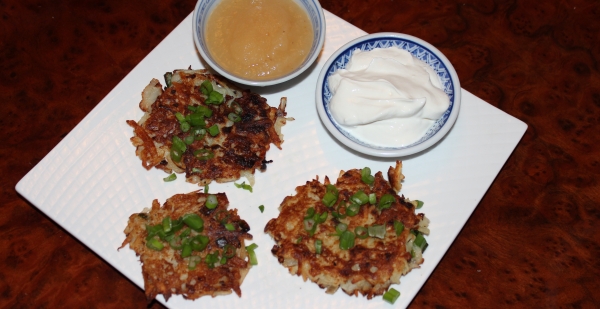
Latkes are an eastern European potato pancake that have a long tradition. Today they have a privileged place in European and American Jewish Hanukkah celebrations but they were also were an important staple in Polish monasteries of the 17th century.
In Hanukkah celebrations, latkes have a symbolic importance as the oil that is used to cook them represents the miraculously long burning lamp oil for the eight days of celebration that occurred during the re-dedication of the Jewish Temple in Jerusalem following the successful revolt against the Seleucid monarchy in 165 BC. As the story goes, the re-dedication of the temple required eight days of ritual purification, but there was only enough oil for the temple menorah (candelabra) for one day. Miraculously, the oil lasted the entire eight days and nowadays a special menorah, Hanukiyah, is available that holds 9 candles as opposed to a traditional menorah that holds only 7. The Hanukiyah is only supposed to be used for the ritual of Hanukkah, and not for any other days of the year or purpose. Hanukkah is also known as the Jewish Festival of Lights and the name means "to dedicate".
Hanukkah is not considered to be a major Jewish holiday, but it's importance has increased since the 1970's when the lighting of menorahs in public celebrations grew more popular in America (although the practice is ancient). In 1974, Rabbi Abraham Shemtov of Philadelphia's traditional Chabad-Lubavitch Center lit a small menorah at the foot of the Liberty Bell at Independence Hall. The next year, rock prompter Bill Graham sponsored Chabad's menorah in San Francisco. In 1979 during the Carter administration a menorah was lit at the White House and subsequently, Ronald Reagan designated it as the National Menorah. The world's largest menorah, standing 32 ft tall, is lit and displayed each year on the Fifth Avenue. Like the Christian Cross, controversy has surrounded the placement of menorahs on public property.
While Latkes are a treasured part of the Hanukkah tradition in Europe and the US, they are not as popular in Israel. Due to economic peculiarities (the rise of Jewish trade unions that favored marketable vs. home cooked foods), cultural influxes of non Ashkenazi Jews and the rise of the microwave among other conditions has led to the predominance of the Hanukah doughnut over latkes in celebrations.
Many other fried dishes other than potato-based pancakes are considered to be latkes and there is, like many older traditional foods, lots of variations in ingredients and cooking styles. The recipe that follows is a standard recipe for potato latkes.
Ingredients:
- 3 large Idaho potatoes
- 1 medium yellow onion
- 1/2 cup of chopped green onions (scallions) (note, you will need more for later)
- 2 eggs, lightly beaten
- 1/4 cup flour
- 2 tablespoons kosher salt
- Light Olive Oil for frying
Preparation:
- Grate the potatoes and onions by hand, using the largest holes on a grater. Alternatively, you can use a food processor.
- Put the potatoes into a large bowl and fold in the beaten eggs, flour and salt.
- On medium high, heat ¼ inch of oil in a large heavy skillet, and gently spoon batter into the pan with a soup spoon or small ladle.
- Press down on the center of the latkes so the batter spreads out.*
- Fry until the bottom is golden brown and then flip over.
- Fry the other side until it is golden brown.
- Remove latkes from pan and pat with paper towels to remove some of the oil.
*The flatter you make the latkes, the crispier they will be.
Serve latkes with sour cream, apple sauce, chopped scallions or, heaven forbid, catsup!
B'teavon!
Recipe by Tom Johnston-O'Neill
- Details
- Hits: 5618
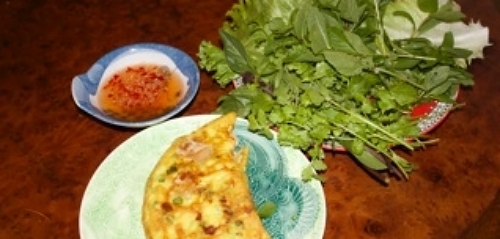
This recipe is from Vietnam, but similar dishes are found in Cambodia and Thailand. The name means "sizzling cake" for the sound the batter makes when it is poured into the skillet. The finished Bánh Xèo looks a bit like an omelet or a crepe, but it has neither wheat flour nor egg. The crepe is made from rice flour mixed with coconut milk. The yellow color is from the turmeric (which has potent anti-oxidants). Bánh Xèo is served like many other Vietnamese dishes, wrapped in lettuce leaves and dipped in a sauce. While the vegetable ingredients are common to most Bánh Xèo recipes, the meat or fish varies from place to place and recipe to recipe. Bánh Xèo can include thin slices of pork (often fatty pork belly), shrimp (often with shells on), squid or some combination there of. Fresh herbs such as cilantro, mint, Asian basil are wrapped with the Bánh Xèo in the lettuce leaves. The dipping sauce, or Nuoc Cham, is sweet, hot, sour with a hint of garlic and fish. You can buy Nuoc Cham in a bottle or make your own. If you buy it, you must dilute the Nuoc Cham with water. Unlike flour base crepes, Bánh Xèo does not really bind together, when it is folded in half it is likely to break, if this happens, don't worry you didn't do anything wrong. Indeed, we found it rather difficult to even get the crepe out of the pan without it breaking apart. My kingdom for a bigger spatula! Sometimes Bánh Xèo is prepared with dampened rice paper which holds everything together nicely. Despite the freshness of many of the ingredients, it is a dish more often eaten in the cooler rather than hotter months. The most common cooking oil in Vietnam is coconut oil which is fragrant and imparts its own distinctive flavor. The batter can be made from scratch (as described in this recipe) or by using store-bought packets that contains both the rice flour and turmeric.
Vietnamese cooking is influenced by the widespread Asian and Southeast Asian notion of 5 elements of taste; sour, bitter, sweet, spicy, and salty. These elements are symbolic of (respectively): wood, fire, earth, metal and water. The elements are also associated with specific organs of the human body, colors and senses. Vietnamese vegetables are often eaten fresh or only slightly cooked, giving Vietnamese food a very fresh taste. A full Vietnamese meal would include many different dishes including rice, a main dish, a stir fried side dish, vegetables (raw, steamed, pickled or fresh), soup, assorted relishes and dipping sauces. Desert most typically would be fresh fruit or a dessert such as Chè, a sweet drink filled with fruits, sweet beans, tapioca, jelly and a host of other ingredients.
Ingredients:
Crepe:
- 1 cup rice flour
- 2 teaspoons of turmeric powder
- 2 cups of water
- 1 cup of coconut milk
- 3 scallions (spring onions)
- 1 pound small white shrimp (either fully shelled or trimmed)
- 3/4 pound of very thinly slice pork belly
- 1 pound of bean sprouts
- Salt
- Pepper
- Coconut Oil (heat a small amount so that it is liquid)
Wrap:
- Leaf lettuce or mustard greens (whole leaves)
- Mint
- Thai Basil
- Cilantro
Dipping Sauce (Nuoc Cham):
- 3 tablespoons lime juice
- 1 tablespoon white vinegar (optional)
- 2 tablespoons sugar
- ½ cup water
- 2 tablespoons fish sauce (Nam Pla)
- 1 small garlic clove, finely minced
- 1 or 2 Thai chilies, thinly sliced
- 2 tablespoons finely shredded carrots (optional)
- 2 tablespoons peeled and finely shredded cucumber (optional)
Preparation:
Batter:
- Cut off the roots of the scallions and remove any layers or ends that are discolored.
- Slice the scallions finely using both the green and white parts.
- In a large bowl combine rice flour, water, coconut milk, turmeric, scallions and salt until smooth.
- Let batter stand for 1/2 hour.
Crepe:
- Season pork belly and shrimp with salt and pepper.
- Brush coconut oil on a skillet or wok that has been heated to medium-high.
- Add two shrimp and some of the pork and cook until both have changed color completely.
- Arrange the shrimp so that they are at opposite end of each other on an imaginary line 1/4 of the way up the pan.
- Position the pork between the shrimp.
- Ladle 1/3 of a cup of the batter on the pan, while swirling and tilting the pan until the surface is coated with the batter.
- Cover the skillet and cook for one minute.
- Add a small handful of sprouts.
- Cover and cook for an additional minute.
- Fold the Bánh Xèo in half, remove it from the pan and onto a serving place.
- Repeat steps 1-10 until all the ingredients are used.
Sauce:
- Heat some water in a kettle or a pot.
- Combine boiling water and sugar into a heat proof bowl and mix until the sugar is dissolved.
- Let cool for several minutes and then add and mix in all of the remaining sauce ingredients.
- Serve in individual bowls
- Eating:
- Bánh Xèo are eaten with your hands
- Cut or break crepes in half
- Lay half of the crepe on a large lettuce or mustard leaf
- Add several sprigs of mint, cilantro and Thai basil to the top and sides.
- Wrap everything up in the leaf into a cylinder shape
- Dip into the Nuoc Cham and enjoy!
Recipe and photo by: T. Johnston-O'Neill
- Details
- Hits: 5778
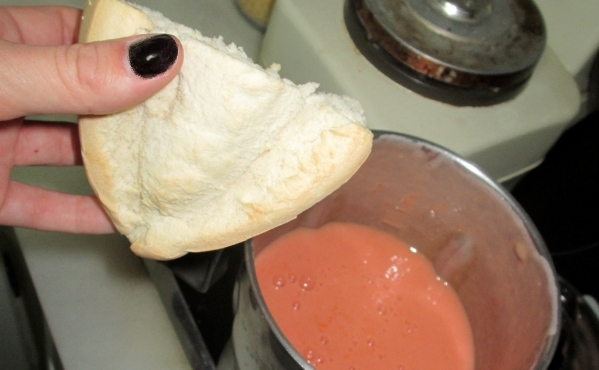
Salmorejo is a dish from the south of Spain. From the simplest of ingredients comes a delicious soup that can be enjoyed in a variety of ways. Using Spanish ingredients (such as sherry vinegar, Iberian ham (similar to Italian prosciutto) and Spanish olive oil) brings out the very best in this delightful Andalusian repast.
Spain, together with Portugal, forms the Iberian Peninsula, or Iberia, which is separated from the rest of Europe by the Pyrenees Mountains. As a gateway between Europe and Africa, as well as the Mediterranean Sea and the Atlantic Ocean, Spain has been much fought over throughout history. Various groups such as the Greeks, Celts, Romans and the Moors (Muslims from North Africa) have all occupied Spain. This long history of invasion is still evident in Spanish cuisine.
Due to this rich and varied history, food has become an integral part of Spanish culture, with each of Spain's regions home to a range of distinctive cuisines and flavors. Spain's culinary traditions rely on an abundance of locally grown vegetables and fruits, spices, nuts, as well as meats, poultry and fresh seafood.
In 2013, my junior year of college, I studied abroad with the CIEE Liberal Arts Program for a semester in the beautiful city of Seville, Spain in the Southern Andalucía region. In one of my classes, which focused on local culture, we were given an assignment to have our homestay families teach us about one of their favorite traditional Spanish recipes. Together, my host-mother and I went to the closest market to gather ingredients to make salmorejo.
Salmorejo is a cold tomato based soup, much like gazpacho, but with a richer, creamier texture. Originally from Cordoba, salmorejo is a typical Southern Spanish dish, and can be found in any home, restaurant or tapas bar in the region of Andalucía. The dish is typically served as a starter or first meal, and can be eaten simply as a soup, or mopped up with bread, or even spread onto a sandwich (bocadillo).
Recipes for salmorejo vary slightly depending on preference, but all contain the basic ingredients of tomatoes, bread, garlic, olive oil and vinegar. The dish is typically garnished with chopped hard-boiled egg and jamón Ibérico, a cured Spanish ham made from black Iberian pigs. It is worth noting that Spanish olive oil (aceite de oliva), as well as traditional Sherry vinegar (vinagre de Jerez) are incredibly delicious, and the dish will truly stand out if made with these traditional ingredients.
Ingredients:
- 2 pounds or about 6-8 ripe tomatoes
- 1 clove of garlic
- ½ cup olive oil (Spanish is best!)
- 2 tsp. sherry vinegar
- Salt and pepper, to taste
- 1 Small Baguette (slightly stale is best)
Garnishes (Guarniciones):
- Chopped hard-boiled egg
- Jamón Ibérico (Iberian Ham)
- Chopped onion
- Drizzle of olive oil
* Authentic Spanish ingredients can be purchased at the Patra Negra Market on Garnet Avenue in Pacific Beach. Tell them we sent you!
Preparation:
- Chop tomatoes and garlic coarsely.
- Break bread into small pieces and soak in water.
- Squeeze excess water from the soaked bread.
- Blend tomatoes, garlic and bread in a blender (adding the bread piece by piece).
- Blend until smooth (3 minutes or so).
- Add in the olive oil and vinegar slowly and continue blending until the entire mixture reaches a smooth, creamy texture.
- Chill the Salmorejo, then garnish before serving.
¡Buen Provecho!
Recipe and photo by Olivia Jelenik
- Details
- Hits: 5930
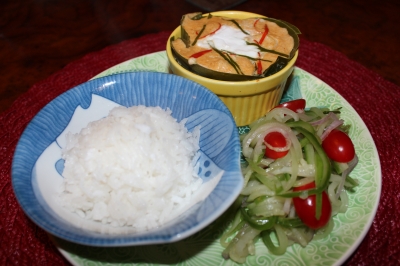
Haw Mok Pla comes from the central plains of Thailand. This dish has a unique taste because it is cooked in banana leaves. Haw Mok Pla is cooked in a steamer or it can be baked in an oven.
Thai cooking has changed quite a bit over the centuries and dishes vary from place to place but certain ingredients are employed widely and are considered essential. Fish sauce is used for saltiness. Palm sugar is used as a sweetener. Tamarind or lime is used to add sourness. It is highly desirable to use these ingredients rather than using salt, sugar or vinegar. Many Thai dishes use a variety of curry pastes (green, red, yellow, sour, Panang). These pastes can be made at home but some of the commercial versions are quite tasty. Similar dishes can be found in Cambodia and Laos. Some recipes call for the fish to be pureed with all the other ingredients, other recipes use small chunks for added texture. A very wide variety of fish can be used, this recipe uses Red Snapper fillets. Haw Mok can be eaten as an appetizer, as a meal (with rice) or at a food stall in Bangkok. In northern Thailand, the mouse is wrapped in the banana leaves like an eggroll and then grilled. Haw Mok Pla (ห่อหมก) is traditionally made in banana leaf cups that are held together by tooth-pick sized pieces or wood or bamboo; however, it is much easier (particularly with previously frozen leaves that are rather more brittle than fresh ones) and less messy to line a ramekin with the banana leaf. Ingredients that you might not find in a regular grocery store (like the fish sauce, red curry paste, banana leaves, palm sugar and Kaffir lime leaves) can be purchased at an Asian supermarket like 99 Ranch Market. If they don't have the Kaffir lime leaves, these can be obtained at Specialty Produce.
Haw Mok Pla is a layered dish. In cups made from banana leaves, herbs (or Napa cabbage) are placed at the bottom, the mousse mixture is spooned onto the herbs and then garnished with a bit more coconut cream, thinly sliced Thai chilies and very thinly sliced (chiffronaded) Kaffir lime leaves.
Ingredients:
- 1 1/2 pounds of snapper fillet, diced
- 2 cups of coconut cream
- 3 tablespoons of Thai red curry paste
- 1 tablespoon Nam Pla fish sauce
- 2 teaspoons of powdered palm sugar (dark brown sugar may be substituted)
- 2 eggs
- 2 teaspoons of cornstarch
- 8 large Thai basil leaves
- several Thai chilies sliced lengthwise very thinly (see photo)
- several Kaffir lime leaves sliced very thinly
For Salad:
- 1 large cucumber
- 2 shallots
- 1 dozen cherry tomatoes
- 2 tablespoons of lime juice
- 1 tablespoon of Nam Pla fish sauce
- 1 teaspoon of sugar
Preparation:
- Cut four 8" rounds from a banana leaf and rinse them in tap water.
- Line the interior of the 4 ramekins with the banana leaf rounds, pleating the edges.
- Reserve a quarter cup of the coconut cream in a small bowl.
- Add the remainder of the two cups of coconut cream to a mixing bowl.
- Add the curry paste, fish sauce, palm sugar, 2 eggs (without their shells!) and cornstarch to the coconut cream and mix until all of the curry paste is completely dissolved.
- Add the fish to the bowl and mix gently.
- Place 2 Thai basil leaves into the banana leaf lined ramekins.
- With a slotted spoon, add the fish, in equal amounts, to the four ramekins.
- Fill the ramekins with the remaining liquid from the mixing bowl.
- Place a dollop of coconut cream on top of the filled ramekins.
- Artistically arrange the chiffronded lime leaves and chilies on top.
- Fill a large pot (large enough to fit the 4 ramekin) 1 1/2" deep with water.
- Place the pot on the stove and arrange the ramekins in the pot.
- Bring the water to a boil, cover the pot and reduce the heat.
- Steam the Haw Mok Pla for 20 minutes
- Remove the ramekins from the pot with tongs, dry the outside of the ramekins with a towel and serve with Jasmine rice.
Thai Salad:
Slice a cucumber lengthwise in quarters. Cut out the seed-filled center and then slice the remaining cucumber thinly. Slice the shallots thinly. Slice a dozen cherry tomatoes in half. Place all ingredients in a serving bowl. Make a dressing with fish sauce, lime juice and sugar. Pour dressing over salad and toss.
Recipe and photo by: T. Johnston-O'Neill
- Details
- Hits: 6268
Joomla!
Extensions
The Joomla! content management system lets you create webpages of various types using extensions. There are 5 basic types of extensions: components, modules, templates, languages, and plugins. Your website includes the extensions you need to create a basic website in English, but thousands of additional extensions of all types are available. The Joomla! Extensions Directory is the largest directory of Joomla extensions.
Components
Components are larger extensions that produce the major content for your site. Each component has one or more "views" that control how content is displayed. In the Joomla administrator there are additional extensions such as Menus, Redirection, and the extension managers.
Modules
Modules are small blocks of content that can be displayed in positions on a web page. The menus on this site are displayed in modules. The core of Joomla! includes 24 separate modules ranging from login to search to random images. Each module has a name that starts mod_ but when it displays it has a title. In the descriptions in this section, the titles are the same as the names.
Content Modules
Content modules display article and other information from the content component.
User Modules
User modules interact with the user system, allowing users to login, show who is logged-in, and showing the most recently registered users.
Display Modules
These modules display information from components other than content and user. These include weblinks, news feeds and the media manager.
Utility Modules
Utility modules provide useful functionality such as search, syndication and statistics.
Navigation Modules
Navigation modules help your visitors move through your site and find what they need.
Menus provide your site with structure and help your visitors navigate your site. Although they are all based on the same menu module, the variety of ways menus are used in the sample data show how flexible this module is.
A menu can range from extremely simple (for example the top menu or the menu for the Australian Parks sample site) to extremely complex (for example the About Joomla! menu with its many levels). They can also be used for other types of presentation such as the site map linked from the "This Site" menu.
Breadcrumbs provide users with information about where they are in a site.
Page 28 of 33