
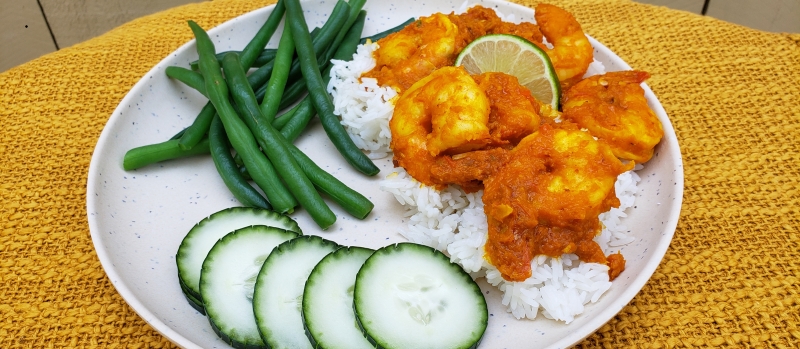
Udang Balado is a spicy shrimp curry from the Minangkabau region of Indonesia. Hot and spicy, this easy-to-prepare dish is sure to become a favorite you will long for.
West Sumatra Indonesia is home to the Minangkabau, the world's largest matrilineal society. In addition to having a unique family system where everyone belongs to their mother's clan (not their father's) and where husbands typically move to their wife's ancestral home, the Minangkabau are also very devoted Muslims. My wife and I (and for 1 year our daughter) spent nearly three years in West Sumatra engaged in anthropological research (ok, not our daughter, her role was to play a spirited and endearing 3-year-old). Due to the incredible good will of the people of Kamang (where we lived), it was as close to paradise for us as one could even imagine. It's a very heady feeling to have an entire village have your best interests in mind. We will be forever grateful.
The word "balado" is the Minangkabau adjective (Minangkabau might be the closest language to "bahasa Indonesia", the national language) that means "with chili" and there are many dishes that fall under this category. My absolute favorite is maco balado (pronounced 'macho baalaado'), a hot chili-based dish made with tiny little dried fish called, not surprisingly, maco. Every culture has its perfunctory ways of greeting people along the road, and in Minangkabau, the pattern is as follows: Q: "Where are you going?" A: "To the market", Q: "What are you going to buy?" A: "I'm going to buy maco." And that is all that is minimally required to continue on your way. Maco balado differs from Udang Balado because the latter has more of a sauce made from a variety of ingredients while maco balado is basically fried dried fish with chilies. As such, even at is incendiary hottest, it is a bit milder.
Indonesian typically eat with their right hand, sans utensils (unless they are eating soup). It is proper and usual etiquette to symbolically offer your food to others if you are in a restaurant by looking at the people closest to you, softly lifting both hands, palms up (as if you were giving somebody something, but the movement of your hands is only vertical) and saying "Makanlah!". "Makan" translates as "food" or "eating" and attaching "lah" to the end of a verb most of the time means "let's", so "makanlah" means "let's eat!". The trick to eating Indonesian food with your hands is to use your fingers to mix a bit of the dish you are eating with some rice and then "pop" the result in your mouth avoiding touching your lips with your fingers. It takes a bit of practice, but it is undoubtedly one of the most pleasurable ways of eating. Needless to say, kids love it too.
Only a few of the ingredients are specialty items, but you can make a fine udang balado without them. "Bumbu" is the typical word for a cooking paste in Indonesia. Bumbu gado-gado (our very first recipe of the month) is the paste for gado-gado. Bumbu udang balado is a paste made from shallots, garlic, candlenut, ginger, shrimp paste, turmeric, galangal and red chili peppers. You can find the candlenut, shrimp paste and fresh galangal root (I find the dried powered version a bit on the bitter side) at 99 Ranch Market. All the rest of the ingredients can be found in just about any supermarket or larger grocery store. The dish can also be improved by the addition of fresh lemongrass, citrus leaves (daun jeruk) and coconut oil for cooking.
Udang Balado can be cooked and served with either shelled or unshelled shrimp. However, to retain the most shrimp flavor, it is best to begin by frying the shrimp in their shells, peeling them afterwards. This dish, like so many other dishes combines the flavors of sweet, salty, spicy, sour and (sometimes) bitter. Some recipes include finely cubed potatoes, hard-boiled eggs cut in half and green beans or "long beans" (kacang panjang). Minangkabau and other Indonesians typically enjoy their meals with a glass of hot water or, occasionally, hot tea. Limeade, ginger beer or beer are also nice complements, but hot water or tea are more common at meals in Indonesia.
Ingredients:
- 1 pound medium large shrimp.
- 2 tablespoons of coconut oil (or substitute a neutral-tasting oil)
- 4 kaffir lime leaves (optional)
Bumbu ingredients:
- 2 teaspoons terasi or belacan shrimp paste (optional, can be bought via Amazon). Another kind of shrimp paste can be used (such as Thai shrimp paste) but the flavor will be different.
- 3 shallots
- 2 tablespoons fresh lime juice
- 1 Roma tomato (1/2 cup of canned tomato can be substituted). Many udang balado recipes don't include tomato.
- 8 Thai or birds-eye chilies chopped very fine. Use gloves and perhaps eye protection. The easy and indeed common way is to use Indonesian sabal olek chili sauce which now can be found in major grocery stores.
- 1 teaspoon cane sugar (or palm sugar if you have it!)
- 2 teaspoons salt (less if using balacan or terasi shrimp paste which are both salty)
- 4 ground candlenuts (optional)
- 1 stalk of crushed lemongrass. Bruise or crush the white part of the lemongrass with a kitchen hammer or the blunt edge of a large knife. You can remove the green part and discard. (dried chopped lemongrass may be used but it is
- inferior in taste).
- 1 2-inch piece of peeled galangal root (may substitute with ginger or use both)
- 2 teaspoons powdered turmeric or for a richer color and taste, find fresh turmeric.
Preparation:
- In a food processor (or go old school with a mortar and pestle), grind into a smooth paste the chilies (or sambal olek), tomato lime juice, salt, sugar, shallots, turmeric and shrimp paste.
- Lightly fry the shrimp in some coconut oil and then remove or retain the shells (note: you will finish cooking the shrimp after you fry the bumbu)
- Add the bumbu, lime leaves, crushed lemongrass stalk, ground candlenut to 2 tablespoons of coconut oil to a frying pan set on medium and fry until everything is fragrant (about 3-5 minutes).
- Add the shrimp, turn continually until the shrimp is thoroughly cooked and well-coated with sauce.
- Serve with boiled green beans (or long-beans!) and rice.
Silakan Makan!
Recipe and photos: T. Johnston-O’Neill
- Details
- Hits: 8573
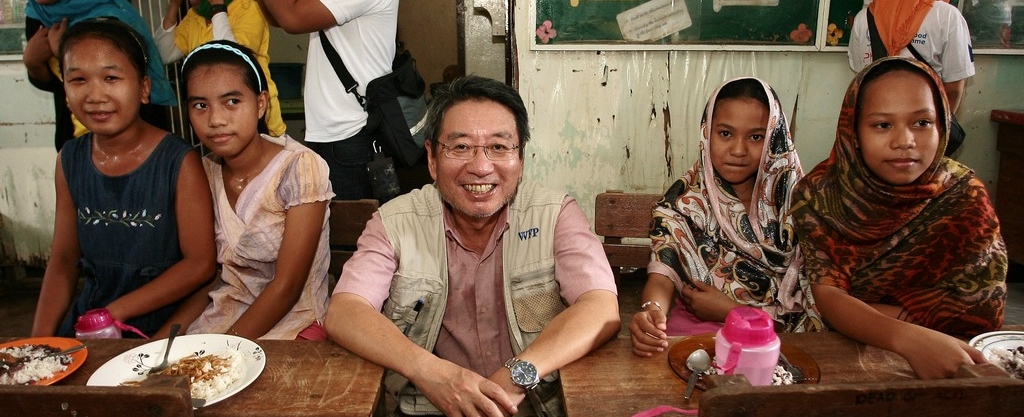
The Worldview Project is delighted to announce that the distinguished former director of the World Food Programme for Asia, Kenro Oshidari, will deliver a talk on Thursday, August 5 at 7:00 PM (PT). The following is an overview of his remarkable career with the U.N. and more about the World Food Programme.
- Details
- Hits: 9099
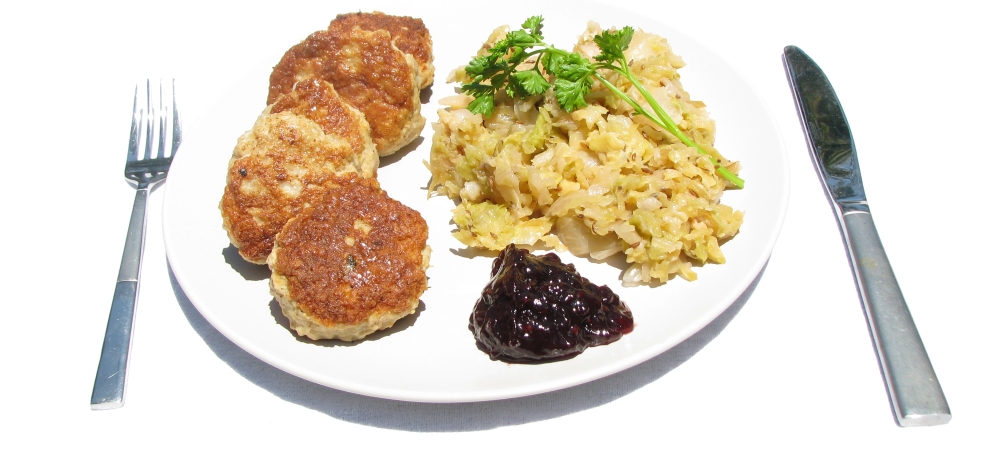
Norwegian Medisterkaker with Surkal and a dollop of blackberry preserves
This month's recipe is Norwegian Medisterkaker with Surkal. Medistarkakar are pork meatballs or patties, and Surkal is a cabbage and apple sauerkraut. Both are relatively easy to make and use easy-to-find ingredients.
- Details
- Hits: 9561
The Participant Observer Recipe of the Month is for Polish Gołąbki, aka stuffed cabbage rolls. A relatively easy dish to prepare, Gołąbki can be eaten as a snack or as a main course. 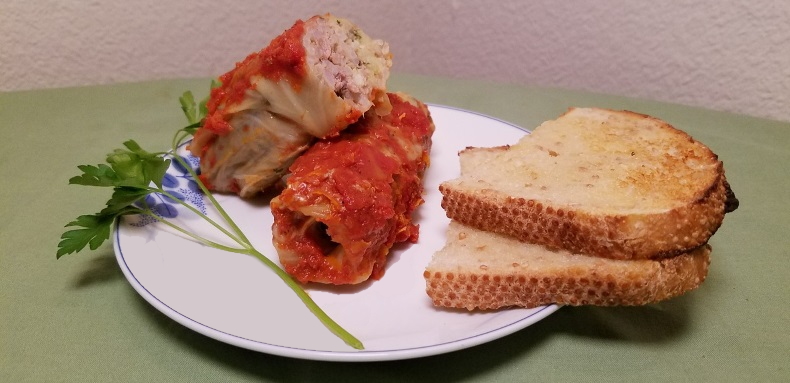
Gołąbki
Few culinary concoctions are as wide-spread as stuffed cabbage rolls. Gołąbki is one of the national dishes of Poland, but stuffed cabbage leaves can be found in much of Eastern, Central Europe, Turkey, Galacia, Greece, Italy, Ireland, Western Asia, North Africa, Scandinavia, China, Korea, Japan, South America and many many other places. Indeed, if you Google a country or culture name along with "stuffed cabbage", you are likely to find a recipe! Stuffed cabbage rolls known as holishkes (or prakas) are often enjoyed by Eastern European Jews and their descendants, particularly for the seven-day autumn harvest festival known as Succoth (in remembrance of the Exodus). It is possible that stuffed cabbage rolls existed in Jewish cooking as long ago as 2,000 years ago, but the immense geographic distribution suggests multiple independent inventions. However, nowhere else are stuffed cabbage rolls as quintessential to a cultural cuisine as they are in Poland. "GoÅ‚Ä…bki" (pronounced "go-woomp-kee") means "little pigeons" in Polish and the same metaphor to describe them is used in Russia and Ukraine. There is also a Polish village named GoÅ‚Ä…bki. Dolmathes are the Greek version of this idea, using grape leaves instead of cabbage leaves. In Poland and Russia, fermented cabbage leaves are sometimes used instead of boiled leaves.
While the type of cabbage is dictated by what is locally available, the ingredients found in the stuffing and accompanying sauce varies. Rice is frequently used, but barley is also used. Generally, lamb, pork or ground beef is used as a protein. The dish is made savory by the addition of onions and garlic and spices are often limited to salt, pepper and perhaps an aromatic herb. A simple tomato sauce is most often used, but they can be eaten with sour cream or plain. The filling is often "bound" with raw egg, making it more solid than crumbly.
Cook's notes:
- There are two main ways of cooking Gołąbki, either by boiling them or baking them. If you boil them, you can use uncooked rice; if you bake them you need to cook the rice first. Once source claims that the oldest technique was baking them.
- Eggs are typically used as a binder, but if you can't eat or don't like eggs, you can use 1 cup of tomato puree.
- Gołąbki freeze well. They can be microwaved, steamed or fried after thawing.
- Like so many other savory dishes, Gołąbki taste better the next day after the flavors fully develop.
Ingredients:
- 1 large head of cabbage (3 pounds)
- 1 large onion, chopped finely
- 1 pound of ground beef
- 1/2 pound of ground pork (optional, if not used add 1/2 pound more of ground beef)
- 2 large eggs
- Olive oil or butter
- 1 1/2 cups of cooked rice (white or brown) cooked "al dente" (in other words, not completely soft)
- 1 tablespoon crushed or chopped garlic
- 1 teaspoon dried ground marjoram
- 2 teaspoons of salt
- 1 teaspoon ground black pepper
- 1/4 cup of finely chopped Italian parsley
- 1 cup tomato puree
- 1 cup beef or chicken stock (or cabbage water)
Preparation:
- Core the cabbage head (cut a conical piece out of the bottom, penetrating about a 1/3 of the way into the cabbage).
- Bring a large stockpot of salted water to a boil.
- Add the whole cabbage (cored side down) , cover the pot, reduce the heat and simmer for 8 minutes.
- Transfer the cabbage to a large pot of cold water to cool it. Note: do not throw out the water it was cooked in; you might need it.
- Gently peel of the leaves of the cabbage one by one. Note: you may have to re-boil the inner part of the cabbage to make the leaves sufficiently pliable.
- With a sharp knife shave down the central vein on the outside (convex side)of each individual leaf to match the thickness of the rest of the leaf. Note: the outer leaves are not as good to use as the inside leaves, and the veins in the inside leaves are less pronounced. Save any leaves you don't use in making the rolls.
- Sauté the onions and garlic in olive oil over medium high heat until they are either translucent or browned.
- Mix in the crushed garlic and sauté for an additional minute.
- Transfer the onions and garlic to a large mixing bowl to cool.
- After the onions and garlic are cooled (10 minutes) mix the rice, ground beef, marjoram, parsley, salt, and 2 eggs. Do not overmix.
- Lay a leaf a single cabbage leaf down with the edges curled up (inside concave side).
- Spoon the filling onto the edge closest to you. Roll the edge of the leaf until the leaf covers the filling, then fold in the sides and continue rolling.
- The amount of filling for each roll varies according to the size of leaf. The desirable target is a roll that is about 6 inches wide and 2 inches thick.
- Make tomato sauce by combining 1 cup of tomato puree, 1 cup of cabbage water or stock, and salt and pepper to taste.
- Placed cabbage rolls in a dutch oven or oven pan. You may need to do this in layers depending on the size of your pan. Pour tomato sauce over the rolls and blanket everything with the leftover cabbage leaves.
- cover the pan with a lid or tightly with aluminum foil.
- Bake the Gołąbki at 350 F for 1 hour.
- Remove Gołąbki from the oven and let cool for 15-20 minutes.
- Serve with rye bread.
Smacznego!
Recipe by T. Johnston-O'Neill
Photos by Shari K. Johnston-O'Neill
- Details
- Hits: 7000
We return to Thailand for this month's recipe and one of my favorite soups, Tom Kha. This delicious soup is a standard offering in nearly all Thai restaurants; once you gather all the proper ingredients, it is very easy to prepare.
- Details
- Hits: 6499
Joomla!
Extensions
The Joomla! content management system lets you create webpages of various types using extensions. There are 5 basic types of extensions: components, modules, templates, languages, and plugins. Your website includes the extensions you need to create a basic website in English, but thousands of additional extensions of all types are available. The Joomla! Extensions Directory is the largest directory of Joomla extensions.
Components
Components are larger extensions that produce the major content for your site. Each component has one or more "views" that control how content is displayed. In the Joomla administrator there are additional extensions such as Menus, Redirection, and the extension managers.
Modules
Modules are small blocks of content that can be displayed in positions on a web page. The menus on this site are displayed in modules. The core of Joomla! includes 24 separate modules ranging from login to search to random images. Each module has a name that starts mod_ but when it displays it has a title. In the descriptions in this section, the titles are the same as the names.
Content Modules
Content modules display article and other information from the content component.
User Modules
User modules interact with the user system, allowing users to login, show who is logged-in, and showing the most recently registered users.
Display Modules
These modules display information from components other than content and user. These include weblinks, news feeds and the media manager.
Utility Modules
Utility modules provide useful functionality such as search, syndication and statistics.
Navigation Modules
Navigation modules help your visitors move through your site and find what they need.
Menus provide your site with structure and help your visitors navigate your site. Although they are all based on the same menu module, the variety of ways menus are used in the sample data show how flexible this module is.
A menu can range from extremely simple (for example the top menu or the menu for the Australian Parks sample site) to extremely complex (for example the About Joomla! menu with its many levels). They can also be used for other types of presentation such as the site map linked from the "This Site" menu.
Breadcrumbs provide users with information about where they are in a site.
Page 17 of 33